Tuesday, February 12, 2013

Splintered Hearts: The Women of Rural Ecuador — Notes from a Field Visit


It is the greatest of all mistakes to do nothing because you can only do a little. 
  — Sydney Smith, writer & cleric, 1771-1845

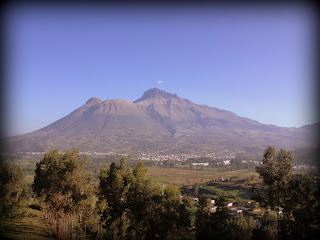
Taita Imbabura (photo:kps)
Driving, we are held by huge peaks. North of Quito, we stop in the verdant farmland of rural Ecuador for baños, fotos, and some maté de coca—that is, bathrooms, photos, and coca tea to temper our high-altitude headaches. There is a series of faint gasps, complete awe, as we step, one-by-one, from the little bus and face what the locals call Taita Imbabura, “Papa” Imbabura, a 15,000-foot volcanic mountain. He’s resting now, but you can see how he blew off a lot of stone and steam 14,000 years ago.

How easy it is to feel small, vulnerable, insignificant in size and time, yet also embraced, never quite alone in this landscape where mountains follow you everywhere. In Spanish, a range of mountains is called cordillera from the root for ‘cord.’ This chain of volcanic peaks is ultimately part of the sprawling American Cordillera that runs all the way to the Brooks range of Alaska, branching out to push forth the Rockies, the Cascades, the Sierras, and my own Coastal range, the Trinity Alps, hemming fog along a narrow strip of Pacific, keeping my redwood home green and wet.

Looking at Taita Imbabura, protective and tacitly potent, reminds me that I once lived 40 miles as the crow flies from Mount St. Helens. From my mailbox, I could watch her sputter and breathe, coughing up ash, the old girl staining a bib of snow all winter. She’s resting now, too. Cordillera, cord, yes, the mountains are connected in some deep, enduring way. I think, umbilical. I think, all people emerge from a common thread. There are many names for the thread—some say, mother or mother earth, others god or the father, others atom or cell, dark energy or pure magic. Doesn’t matter the name, the thread is there and we all cling to it.


Checking out the visitors
with all of their
cameras & gadgets
(photo: kps)
Distant, watching us arrive, each child is smaller than my thumb, my camera a tiny window through which they enter my life and grow large. The bus stops, and several sets of eyes, like flecks of polished mahogany, peer up at us. We’re at a pale terracotta building at the heart of this village. The children dissolve into side streets, and we’re led through 12-foot high, carved wooden doors that suggest something important waits inside.

We enter a classroom where 6 women sit in a row.  Unexpectedly, my mind flashes an image of cormorants lined on a half-sunken limb, bronze faces angled in the air, reflecting little shafts of sunlight—the storms, the adversities they’ve flown through, transformed to radiance. 

Trainer-Mothers
of a Carchi Village
(photo: kps)
Who are these women?  We’re told they are indígenas, mostly indigenous women of this village in the northern province of Carchi,Ecuador. All have been touched by violence, discrimination, or economic despair—but that’s not what defines them. As we talk through our translator, we understand they are wives and mothers who began as almost invisible girls, now turned social architects building a new community that their children will one day lead. I’m not exaggerating. The poetry isn’t in what I’m saying but in what they are doing.

Today each woman will share her testimonio, her private story. We’re colleagues, mostly US natives, with ChildFund International, and we’ve come to see our Early Childhood Development (ECD) program in action, to learn from these local women. We want to understand if our initiatives really are transforming the lives of children and families. We want to gauge the impact of our donors’ charitable gifts in the field so we can collaborate with our donors when we’re back home to expand the program’s reach.

Curious Toddler
(photo: kps)
Waiting for our dialogue to begin, I consider the mountains far beyond us, propping up the sky and listening. How many human voices have they heard over millennia, and what did the voices speak of? A saying comes to me, “Women hold up half the sky,” the best sentence Mao Zedong ever uttered. In truth, some women hold up all of the sky for their families.

In the doorway, other ears listen—a toddler in a monochrome jumpsuit and khaki cap flashes us his round, red cheeks and small, serious mouth, looking more Chinese comrade that tiny Ecuadorian. He sways in the massive threshold, his balance on two feet a tenuous effort, before his abuelita, his grandma, takes his hand and leads him away.

Children. The good news about decades of humanitarian efforts to reduce child mortality around the world is that, yes, more children today are surviving. The new challenge is that about a third of the world’s children are only surviving, not thriving, so we’re at a critical juncture. As a world community, if we don’t help families raise healthy children—physically, intellectually, emotionally, and spiritually—we’ll have a planet with more problems and fewer sources for solutions. Worse, more than 200 million young children today won’t have a chance to discover their own potential.

My parents drilled into me that I could be whatever I want to be with hard work and high sights. Unfortunately, that’s not true for countless children, particularly those living in poverty.  A child can’t set her life loose and fly if she lacks nutritious food, clean water, a safe environment, effective parenting, quality education, opportunities to play and explore her capabilities, and other basics that we take for granted. No, a child can’t fly if he starts life in hole so deep and narrow that he can’t unfurl his wings.

Sitting in a row, the women are a study in contrast. Some faces seem pure Inca, others more defined by Spanish features, and a few are reminiscent of the native people of my California redwood coast and could pass for Yurok or Hoopa. Their clothing is a confluence of traditional and contemporary, alpaca sweaters with blue jeans, native skirts with button-up shirts.

A Trainer-Mother shares
her story (photo: kps)
Once women who struggled alone, now they are friends, collaborators. They’ve been trained to understand ECD concepts, they’re raising healthy children, and they’ve volunteered to be ‘trainer-mothers,’ teaching other mothers and mothers-to-be what they have learned. This pass-it-forward approach is what makes ECD initiatives cost-efficient and sustainable over time.

My wireless headset sputters static into my ears, waiting for their words through our translator, Marcos. It’s odd, as these women’s stories will pour into me in a male voice. The women huddle, exchange glances and a few words in whispered Spanish. One woman agrees to begin. She’s perhaps 40. She perches on the edge of her chair, adjusts a jacket around her full body, tucks an ebony strand of hair behind her ear, and speaks low and calm.

“I was hurt as a girl by my mother and then by my husband. This I thought was normal,” she says. “Also, my mother, I saw her abused many times by my father. So my first two children, I hit them. I worked long days, then came home, and they would not behave how I wanted, so I abused them.” This mother looks away, brushes a knuckle at the corner of her eye, composes herself, and faces us again. “Another woman came to my house and said ‘you abuse your children—it is wrong.’ At first, I was angry, but then I could see her children were more happy. She told me about meetings that ChildFund offers here, so I came, and there were these other women, and I learned.”

After she finishes speaking, another woman begins. She has short hair and wears a white cardigan, her hands interlaced in her lap. She is unmarried and childless. She became involved in the ECD program because she was concerned about her nieces and nephews—they were very small and thin. “I thought I could learn and teach the women in my family.” 

A third woman with deep, ruddy skin and a silky pony tail follows with her story. She is a mother and a grandmother. Her husband threatened her if she kept coming to the ECD program meetings, but she persisted. She eventually left her husband, and now helps her daughter raise her granddaughter. “Violence never helps a child,” she explains, “violence only takes the child’s spirit away.”

Listening to the women, I remember the slender book of poems in my backpack, a certain line by poet Elana Bell that goes, “We are inside the dream of a God who’s forgotten us.” I search each face and wonder if these women have felt that way. It's a farming region here, so long days are spent on others’ land until they return home to their first jobs as wives and mothers, a few hours of sleep, then gone again in chilled darkness. Among their hands, so many fingers are darkened by sun and soil, little arcs of dirt under nails, the land always with them.

A toddler during an
ECD training session (photo: kps)
More women speak, projecting a quiet grace—their Spanish a kind of simmering, a warm rhythm, filling the room. We bob our heads, affirming what we hear. I scribble sentences from the various testimonios:

“I didn’t know to talk to my children when they were little, since they could not talk to me. I thought children should be quiet. Now you see this boy, he’s my youngest, 4 years, see how he talks and talks. I think he is very happy talking.”

 “My husband said it was a waste for me, a woman, to learn. I thought I was being a bad wife, but no. Our children began to grow healthy and strong. My husband, he can see the difference. Now he comes to some meetings also.”

“I always loved my children, but I didn’t understand that that some ways of loving are better than others. Giving proper foods, for example, is important for the child’s mind to open. Healthy food is one way to love your child.”

Sharing one's 'testimonio' ... a tissue helps.
(photo: kps)


“My heart is full of splinters, but I learned it is strong, it can love beyond pain.” Ah, her pain has turned her poet!

“I learned that to play is how children learn to use their hands and eyes and bodies. To play is also good to make the bond between a mother and child strong. You see, it is not a waste of time to play.”

“Did you know that watching your mother be abused by your father can affect the way you grow when you are a child? I did not know that; now I do.”

“I never thought about being happy. Life is meant to be hard, I thought. But no. Life is very short, and to be happy is important. I cannot always be happy, but I try to be less sad so that my children can be more happy.”

“It’s better to lose a day’s work to take your child to the clinic. Some illness may not kill a child, but it may secretly harm his brain.”

 “We forgot our songs, how to sing to our children. I needed to learn to sing to my children, and now I also sing for me.”

“I admit I locked my children in our house while I worked. Sometimes they hurt themselves. I saw my daughters were growing old and sad without their mother.”

“I feel blessed. This program, these women, I know so much love. My life, I feel it is blessed.”

As each woman talks—one tipping her head to the side and leaning forward, another flashing her eyes from faces to floor to faces to floor, still another crossing her arms over her midriff as if to protect her vulnerability—I watch my colleagues. We’re cocking heads and leaning in, we’re looking and looking away, we’re crossing our arms. Unconsciously we’re mimicking the women’s bodies, gestures, the physical reality of what they are saying. Our bodies don’t need a translator to understand each other.

The women tell us that all their children are ‘registered,’ grandchildren too. Two days ago, I wouldn’t have understood the significance. Yesterday we learned that a man in another community refuses to register his girls, ages 2 and 4. Unlike our own country, where a birth certificate is automatically generated and a new life is made real on paper, here parents need to register their children’s birth for them to legally exist. It’s usually men who avoid the process, who, we’re told, may not want to incur financial responsibility for the children. It’s often girls who go unregistered, though sometimes boys, too.
A mother with her children in the
Early Childhood Development (ECD) Program
(photo: kps)

I never considered the need to legally exist. I thought the sheer presence of my body taking up space, displacing water in the bathtub, making cloud-breaths on cold mornings, and leaving rosy lip prints on a tea cup were sufficient to confirm, ‘Yes, hello, I’m here!’   

When I think of children having innate rights, I never expected that the most basic right of all, the right to exist, in one’s own community and country, is one that would need to be passionately asserted. The woman sharing this story yesterday curled her hands into fists that she softly pounded in her lap, explaining, “ I told this man, if you do not register your girls there will be no school for them, no medical care, no extra food from the government, because, you see, this family is having hard times since the man does not work, only the wife.”

A program consultant with our group explained to us that without the birth certificate created through the registration process, children are also vulnerable to abduction for the purposes of foreign adoptions or child trafficking for forced labor and the sex trade. The translator converted her information to Spanish. It was news to us, but the women nodded, knowingly. The soft-fisted woman, her hands finally open as if two cups she’d emptied, finished with, “I told the man if he loves his girls he must give them a name and register them.”

That’s when I understood the deeper twist to this dilemma: children who go unregistered often also go unnamed. What? A nameless child? I asked for clarification through the interpreter because it seemed impossible that a parent wouldn’t assign a name to his child. At the very least, there had to be a name so the parent can get a child’s attention or have some way to speak about the child to others or even to think about the child.  Human beings are not only defined by opposable thumbs but by our penchant for wanting to give everything a name.

We name places and things, we name animals and birds, we name the kinds of rocks we skim on a lake that may have different names depending upon our language and culture. Right now I think, Lago Sandoval, Sandoval Lake in the upper Amazon of Peru. The name summons the lake, brings back to me a rich memory of a rainforest, steamy air, scent of sweat, the constant buzz of cicadas, and the surprise of palm-sized Blue Morpho butterflies, opening and closing their luminous wings. Wow, all of this out of a name while I sit thinking in a classroom in rural Ecuador.

Every word we utter is ultimately a name: wind, cloud, volcano, sorrow, love, which could be amor or cariño in Spanish and in Quechua, munay, though munay describes a range of emotion broader than what we call love. I try to imagine myself without the name my parents gave me. Would I be someone else without a name, or with a different name, say, Elizabeth or Soledad? There’s the paradox about naming: words—names—open the world to us while simultaneously forming a lens that limits. Maybe being nameless has more possibilities? No, I’m certain, children need names even more than birth certificates. To hear your name called is to have your life affirmed, to know you matter.

A small face appears in the doorway. The toddler again. His mouth is now agape, in a perfect ‘O,’ as if paused in mid-thought. He surely hasn’t learned the words gringos or Americanos, so doesn’t know how to name our little group of visitors taking photos with electronic gadgets, though he’s probably already heard iPhone. Our necks are craned to look into the screens of our phones and cameras, checking the images we’re capturing. The boy probably assumes we are a permanently hunched-over people with hyper-active thumbs. I smile, others see him and smile, and he wobbles back out of sight. When I see him again, I’ll say, como se llama, what’s your name, and hope that he or his abuelita will have an answer.

Rufous-collared sparrow ...
a common bird of the Andes
with a lovely song
(photo: S. Listengart)
In the courtyard, waiting to leave, there’s another toddler in a pink alpaca cap, her body bent over as she focuses intensely on a piece of string by her foot. A grey poodle trots along a wall lost in the dog-world of smells. A Rufous-collared sparrow pecks then scratches at a crack in the pavement. Sunlight through a railing falls in a complex pattern over the child, the dog, the bird, as if to make a wholeness out of these three loose parts. Perhaps the wholeness is only in how I will remember this moment—this peace, the ease of these three, fully absorbed in the same yet individually separate moment. Suddenly the toddler topples onto her bottom, deciding whether to cry. The dog’s head pops up and turns to the child. The bird bursts straight up on brown wings and becomes sky. We are all changed by the child. Briefly we are in her moment.

We travel and stop, travel and stop. Right now we’re stopped on a mystery road off of the Pan American highway. I scan distant trees for birds, and notice shaken limbs and lurching silhouettes. As I lift binoculars, I see the trees edge a school and an empty field. Panning the foliage, there are children in school uniforms, navy and white, climbing into dense, green crowns. From the top of their world, they are releasing white birds, one after another, that swoop and dive to ground … no, paper airplanes!  Immediately I’m launched into a memory of my younger self, the sensation of shaping paper into a plane, scraping my small crooked fingernails along the folds to form sharp creases. I’m smiling: so many engineering efforts, failed designs and paper cuts, daring climbs up other trees, such joy in a flimsy flyer that for a little while stayed aloft.


Slowly, the little gods of paper, mostly boys but a few girls, clamber down, bouncing on branches, then jumping free, landing with a roll, human origami unraveling. Small children wait below, running in circles around the trunks with their arms outstretched, heads tipped back, eyes aimed up. These little ones are flying. Above, Black vultures glide on invisible thermals then tip sideways, flashing their silver fingers over the children, their shadows combing leaves and hair. This is not a dark image, the vultures spiraling low, this is an image of lightness, buoyancy, possibility. A vulture can fly for six hours without flapping her wings. Children can fly on imagined wings until the teacher comes to call them in, until someone tells them they’re rooted in the earth, and they turn to paper.

Being so close to the equator, when we stop at a house nestled in a sprawling patchwork of crops, I’m not surprised how maize, beans, sunflowers, and a few bougainvilleas are thriving. I’m a light-lover. I need brightness in my home, my office, even if it’s the diffused glow of a sun I can’t see pushing through fog. So, when one of the trainer-mothers, Renata, welcomes us into her home, though I feel honored to enter into such intimacy with her, I also feel as if I’m entering a cave. Her green and white house is a string of rooms without many windows. I realize immediately why I’ve seen so many people spinning, cooking, carving, washing, or standing in doorways looking out—they need that threshold of light.

In the home of one 
ECD Trainer-Mother  with youngest son. 
(photo: kps)

Renata has arranged white, plastic chairs in circle in her living room, and our group settles in, eyes scanning the room curious and awkward. She sits in an easy chair with her son, Elias, age 4, on her lap. Above her is a sign that reads, “Dios es paz,” which even with my limited Spanish I recognize as “God is peace.”  Walls hold a mix of children’s cut-outs that include a pink baby and a smiling yellow cat, a calendar, a framed document with photos, and a small crucifix.  Her ceiling is covered with a green tarp, her floor is cool cement, a ruffled cotton curtain is the ‘door’ to the room behind her, which is dark. A plant on a shelf bears a single red blossom, and a puppy occasionally wanders by to sniff in the scent of foreigners. It’s a simple home with two surprises, a new washing machine in the corner and a CD player that plays children’s songs for Elias.

“Welcome to my home,” Renata begins, pausing to ensure the translator is following. “Thank you for coming from so far away and thank you for the ChildFund program for mothers, which has changed my life and the lives of my children.” For the next twenty minutes, she tells us about her life.

Renata has four children. Her husband left her awhile ago, and though he sometimes was ‘aggressive’ with her, it is hard without him. She takes classes and hopes to complete her high school education. She’s proud to have graduated from our ECD program and nods toward the certificate on the wall. She cares for an aging father. Her mother died, but shouldn’t have, because the proper medical care was in another community that they didn’t reach in time. She leaves home before 5 a.m. to work at someone else’s farm, then comes home to tend her own crops and feed her family. She was abusive to two older children, verbally and physically. One is a mother now, a good mother, she emphasizes, also in the ECD program. Tears shimmer on her high cheekbones. She’s being specific, detailed about her actions, and I pick out the words for ‘hit’ and ‘hurt,’ and then “palabras terribles,” terrible words. Twice she refers to herself as ignorante, and cries harder when she says, “pero ahora sé, entiendo,” that is, “but now I know, I understand.”

I wonder if I would invite a group of travelling Ecuadorians into my home. I feel invasive, a bit of a gawker, but also empathic, somehow meant to be here. How healing for me would it be to share, out loud with strangers, what has hurt me, how I have hurt others, what I have learned, and what gives me hope?  So my responsibility, what I must do, want to do, in this sparsely lit room for Renata, is listen and witness. What I feel as Renata speaks is the double-edge of knowledge, the freedom and the burden it bears. Knowledge is a burnished feather that lifts a body up, but the gravity of what’s been done in the past, the awareness of how awful each of us can be at times, tries to bring the spirit back down. 

Renata's puppy
(photo: kps)
Elias grabs a colorful, illustrated pamphlet, part of the materials that Renata uses as a trainer-mother to mentor other women out of a cycle of poverty-driven inexperience, illiteracy, neglect, and likely, depression. Several times, patiently, she slips the pamphlet from his hands and sets it on a table, rubbing his back with her palm while she speaks. Feeling watched by so many eyes, Elias gives up and buries his face in his mother’s shoulder.

Renata explains how she now uses a ChildFund development scale, a guide that defines the parameters of a healthy child at specific ages and stages of growth. She measures how well Elias is growing intellectually and physically, in terms of cognitive abilities and motor skills. She says, the real measure is “he is a happy little boy, and I am a happy mother.” She invites us to ask questions, and we do.

Yes, she would like to marry again. No, there are limited employment opportunities, just the farm work, but she is exploring with other women the possibility of starting handicraft businesses so they can work at home with their children near. Yes, she has become closer with her older children. No, she doesn’t have help with her father, but she prays for him.

Finally, someone asks what the most important thing is that she has learned from the ECD program and from being a trainer-mother. She closes her eyes for a moment, nodding, then opens them, her lashes glistening with emotion, saying, “I learned how to love my children better. That is the most important thing. Sometimes, with Elias, I sit on the floor and watch him play. I’m so happy then. I did not do that with my older children. I have many regrets. But I know it is better to look to the future.”

A smile and a wave ...
(photo: kps)
Renata sprinkles her story with certain phrases: con la ayuda de Dios, with God’s help, and salvación. I recall from my Latin that salvation comes from salvus, which is further rooted in an older word, sol, meaning whole. I scan my colleagues. We’re all tilted forward, tissues in hand, sitting in an imperfect circle that reaches around and is completed by Renata and Elias. Whole. Alone, we are broken pieces of something larger. Gathered together, we share this momentary wholeness. Sol, as a Spanish word, is sun, which comes from other roots related to shine and peace. Leaving Renata’s home, I turn and look back to see her smile and wave, shining and peaceful.

Late afternoon, we pause to explore a lake, a bowl of dark, hazel water surrounded by green parcels that roll for miles into dry hills, then jagged, grey ridges, and finally bright clouds. Two Pied-bill grebes glide away from the edge as I approach; they dive then pop up mid-lake, the black stripes on their stubby bills, gleaming. I track one cormorant across the surface to a limb jutting up on the opposite bank where about a dozen cormorants perch in a line. Neotropical cormorants, they are mostly bronzy females and a few dark-pewter males, one of whom outstretches his wings, casting the shadow of a cross angling the water.  Suddenly the women come back to me, all of them sitting in a row along the white-washed wall. Yes, radiance takes many forms.

A calm, afternoon lake in the Ecuadorian Andes (photo: kps)
Evening comes as we go. Rumbling through little towns, we notice how the people live as much outside as behind walls. Up narrow streets, metal grills puff smoke as women roast potatoes, corn, bits of pork or pollo, their mantas pinned to leave their hands free and shoulders warm in the waning daylight. Dogs pace and fidget, excited by the smells—shooed away with wooden spoons, they keep skulking back.

Road-side dog of
rural Ecuador
(photo: Shelly Perry)
Dogs, all types, wander throughout the Andean plateau, the villages and cities, the farms and hedgerows, streets full of people and cobbled nighttime roads where careening trucks won’t bother to stop. Like a parallel culture, the dogs live among the people as if other people, poorer but, in some ways, freer. Many in our group are animal lovers, and when we see matted terriers and emaciated labs, we’re brought close to tears. Yet seeing how so many people struggle and suffer, it seems a luxury to grieve so easily for dogs. It’s not that the poor don’t have animals that they love and mourn—empathy has nothing to do with income—but there must be a limit to how much despair anyone can witness and absorb.

It’s three flights from Quito to my foggy, cliff-side airport on California’s far north coast. The first plane follows a string of volcanoes toward Central America, then plunges into pure white. I doze and wake, my porthole turned blue. The sky, embracing the plane, and the Pacific swelling below are one. Air, ocean, my open eyes—all a unified blue.

Back in the States, a seven-hour lay-over in Houston is a delicious opportunity to read, though the jolt of English speaking—televisions and people bickering on cell phones—is a distraction. The Andes seem far away in distance, time, and reality. I was there, wasn’t I? Donde estan las mujeres y los hijos? 


Remembering an ECD training session in Carchi, Ecuador
The day drifts by in the huge, airport windows, until the sun dips toward the Gulf. The sky turns dazzling and surreal, an evolving spectrum: bronze, salmon, pale pink then lavender to periwinkle to grey, heaven airbrushed to earth. A faint green blush appears, then a green flash, as the sun sets into the last scrim of clouds. Lasting only seconds, the green dissolves to dusk.

I’ve only witnessed such a flash a few times, so I open my iPad and search: ‘green ray.’ The first links emphasize rare, a mirage of photons, dust, and horizon. I start to second-guess myself—I’m tired, maybe I didn’t see it—until another source says the phenomena isn’t rare at all.  Green rays may be visible most days in many places. What’s rare is seeing the phenomenon, stepping out of one’s private universe to pay attention, to look at the world and see it as it really exists.


Changing the future for our world's youngest children,
usually starts with mothers ... it helps if the rest of us
see their resilience and join with them.
(photo: kps)
Note: A special thank-you to the many women my colleagues and I met in the provinces of Carchi, Pichincha, and Imbabura, Ecuador. They opened their lives and homes to us to build understanding. They showed us how they are transforming their children's lives ... and along the way, their own. All names have been omitted or changed for some measure of privacy. The ECD programs in which these women are involved are made possible through charitable contributions from individuals & families, foundations & corporations, and others in the US and around the world. 

Thank you also to ChildFund Ecuador and to our program partners working with us in the field who welcomed us to their Andean landscape and facilitated our dialogues directly with the women, men, and young people who are creating sustainable change in their communities. To learn more about ChildFund International's work, touching 17.5 million children and family members in 31 countries (including the US) visit the website at: www.childfund.org. 

Saturday, February 2, 2013

One Birthday, Remembering Another


 “I just can’t comprehend
Whether it is the end of the day, the end of the world,
Or the mystery of mysteries in me again.” — Anna Akhamatova

Evening comes to Luna Lodge, near
Parque Nacional Corcovado, Oso Peninsula, Costa Rica
(photo: Terry Schulz, 2/2/12)


    Sun Setting

     Go now. The day’s done. Let me
     open my body and see what flows out.
     Remember the ocean’s edge at Corcovado,
     where rainforest collapsed to beach and sea?
     Each time the tide pulled away
     hundreds of tiny fish silvered the sand,
     gasping, flailing, the shimmering Pacific slivered,
     such beautiful desperation.

Tuesday, January 1, 2013

Sanderlings Making Their Own Poem


“Let yourself be silently drawn by the strange pull of what you really love.”  — Jalaluddin Rumi

Happy New Year from the Redwood Coast …. 

To see Sanderlings Making a Poem click here J

Sand Making It's Own Art at Clam Beach - kps


Kayaking Big Lagoon ... calm now, but later swells - kps


Sun warm ... water cold - kps

Temporary architecture - kps


Waiting for the Anna's hummingbird
to find the late blossoms - kps

A little sports, a little napping, a good start to the year - kps


Forget sports ... a nice nap in a quilt - kps

Monday, December 31, 2012

New Year's Eve: What I Found in My Notebook


 “And no, we don’t know where it will lead. We just know there’s something much bigger than any of us here.” — Steve Jobs

December 21, 2012 

Hello, we’re here. Hmmm, who’s we? We’re always at least two people. One is visible through the lamp-lit window, scribbling, audible, whispering these words as dust motes fall slowly like lazy shooting stars. The other one is some relentless tyrant of thought. New era, she reminds. No, just another winter solstice. What? Just a winter solstice?  Less than 100 winter solstices in a typical lifetime, and this one, your 53rdTomorrow there will be 18 seconds more of daylight, this solstice, this moment, gone. It’s always a new era.

There was cat fur in my tea, and I just swallowed it … so that is how ritual begins. And for many years, she celebrated the solstice by drinking a little cat fur with her tea at 5:42 a.m., a certain Ceylon from Fiji or green jasmine from the sacred source, Amazon (dot com). I am writing in dust, on a piece of dead tree. The tyrant chides, pay attention. Sometimes when a fleck of dust hits the coiled bulb, it sparks, a tiny explosion, and you can almost hear out of the florescent buzz, I was here, look, I was here.

Thursday, December 20, 2012

Waiting for the New Era


“The end is where we start from.” — T. S. Eliot

 If  I  Could  See  the  End  Coming

             I would wait for it. Where?
             Beside the sumacs, under the beech
             where the animals I’ve grieved
             are a trellis of bones. I’d ask
             the Carolina wren to spill out
             her song, and as the world condensed,
             hyacinths, peonies, stargazing lilies
             would bloom together, bathing everything
             in their thick, sweet scents.

I wouldn’t expect a sudden white light
or a familiar crowd on the horizon
waving me forward—just trees hiking
down the mountainside, winter creek
softening at the edges, filling with snowmelt,
tumbling toward me. My husband,
a river-runner, would be holding a trout
he carved from redwood burl, curved grain
giving momentum to fins, his voice
only in my head. “If you’re swept away,
point your feet downstream.”

             Beyond me, there’d be leaping,
             the sporadic glimpse of deer, squirrels
             threading understory. I’d nod
             to a single black bear up on two legs,
             the last wild man, savoring the air
             above his face. I’d watch the low moon
             step down from a locust branch, pause
             at another, and slip away. All would be,
             or seem, a slow process, like falling
             in and out of love, again and again,
             with the same person for years.

Many thanks to The North Coast Journal for publishing this poem in its 
January 3, 2013 Issue. Hurray, we made it into the New Era ... now let's
hope  for a global community where enlightened & empathetic actions   
lead the way.

Thursday, November 22, 2012

Another Thanksgiving Day ... Thank You


photo: kps, autumn comes to our pond's edge
“I thank you God for this most
amazing day, for the leaping greenly
spirits of trees, and for the blue
dream of sky and for everything 
which is natural, which is infinite, 
which is yes.”
—e. e. cummings, poet


Thanksgivings

remembering Rosie

For years, it was like this:
a terrier through the window, barking,
the steps leading up, weathering grey,
all of them, arriving, as fog dissolved
to a wreath of ravens’ wings in blue sky,
and for awhile there’d be 25, maybe 40,
familiar bodies, crowding, as if another
cluster of mums on the deck,
ruddy faces, round and open, taking in
each other’s light, the gates
to her little yard, sagging further
on their hinges.


Monday, October 29, 2012

Every Child a Caroline & Other Possibilities


“A baby is God’s opinion that the world should go on.”  
 —    Carl Sandburg, poet


When I first meet Caroline it’s as if looking into the moon—a bright pool of light at the end of a long day in a darkened room. Eight hours of meeting chatter and PowerPoint presentations distill into this wordless babble, this round baby face, this orb of luminous mewing and gurgling followed by a squawk. Caroline’s hands are fists, pink-knuckled buds that open toward the approaching form she recognizes as mother.

That her mother is named Sarah, that we passed a row-house yard where a single viburnum bush flamed red and orange in late October light, puts me in a biblical miracle kind of mood. I’m a bit wonky from jet lag and lack of sleep and lots of listening and thinking. I’m in Richmond, Virginia, two days into a four-day quarterly gathering of fund-raisers working on behalf of children under the umbrella of ChildFund International.

Wonky, yes, and suddenly anything seems possible. I look around the baby room, one chamber in a stately old home turned daycare center. The room is vintage but full of color, toys awaiting play, the murmuring voices of caregivers tending to their pint-sized clients. There are tall, old windows and small, new faces to look through them. A micro-world nested within a macro-world. The toddler in the corner watches dust motes in a sunbeam, and it seems plausible that she is working out her own theory of relativity.

Beauty flickers from the edges of everything, weedy and persistent, this moment a crack in the sidewalk, a pause in the day, which always wants to move you forward to something else. It seems reasonable to expect flowers, purple lupine or orange poppies, to sprout from a toppled toy truck or the stray baby shoe abandoned in the middle of a rug. Okay, maybe we’re not talking world peace by midnight or the abolishment of political ads, but it does seem possible that happiness is the natural order of things, that if you extend your awkward hands into air, you’ll discover how incredible they are, how enough you are.

It’s approaching 6 p.m., so only a few babies and toddlers remain to be retrieved by parents. There’s an infant cradled in a half-donut-shaped beanbag, safe yet with the illusion of independence—babies like that—and he, or is it she?, is studying the ceiling with grey-blue glossy eyes. Infant eyes always remind me how otherworldly we are in the beginning, aliens landed, dazzled by the ordinary.

One drooly little guy, a tiny drunken sailor, staggers and lurches my way. He grabs my trouser leg for balance, looking up at me, smiling, all wet gums and nubs of new teeth.  He tips his head back and lets his mouth fall open, stringy globs of drool landing on my shoe, as he stares way up. He’s heard, perhaps, I’m from redwood country. To him, I’m a redwood full of ravens he’s trying to spot without binoculars.

Caroline examines Sarah’s face, considering her options: Do I give my Mum my dumbfounded, merry, you-are-the-love-of-my-brief-life face, or do I squeal and scowl at my caregiver dressing my bottom? I realize this is the decision on which the world always hangs: to smile or to snarl? How any of us answer that question is a tipping point—away from or toward—war, divorce, a lousy day or a good one.

Sarah, my colleague whom I only slightly know, talks coo-y—not baby talk, which babies find annoying, yet not the professional tone she used during our meetings today. She leans her face into the milky perfume of Caroline’s breath, “Hel-lo Car-o-line!” Sarah’s voice is reassuring and vulnerable at the same time, a blend of I-want-everything-for-you and I-know-I-can’t-protect-you-from-life.

For some reason, I whistle at Caroline. She gapes and grins. She thinks I am a musical genius, another Wynton Marsalis, or one of Lady Gaga’s back-up singers. She’s teething, though, so maybe she’s only estimating whether she can fit some part of me into her mouth, my nose or earlobe, a bit of cheekbone to gnaw.

This feeling keeps washing over me, sublime possibility. Autumn light floats through the windows at a low angle, the room glowing amber, the day not yet done. Then this thought: Caroline is a sample. One of her own hands now stuffed in her jaws, feet kicking with joy to be lifted into her mother’s arms, her moony face finding the singular curve of Sarah’s neck, it hits me: Caroline is how it’s supposed to be for all children.

It’s an accident that I am here in the baby room with Sarah and Caroline and my sailor buddy still hanging on to me and a few other crawly humans. I missed a ride with another colleague to dinner so Sarah invited me to tag along with her, if I didn’t mind stopping to pick up Miss Caroline. The reward is a free shoe shine—baby drool really brings out the luster of leather—and this unexpected wave of possibility.


It’s been four months since I returned to ChildFund to work with Sarah and others in building the fund-raising program. It’s about relationships, finding and connecting with people who want to change the lives of children as much as we do. Among our priorities is enabling ChildFund to expand its early childhood development programs that already touch millions of children in 31 countries. The good news is that the humanitarian field and my organization are indeed saving the lives of children and their mothers in some of the poorest, once-ignored places. Now it’s time to move more children beyond surviving to thriving. 

My first sponsored child,
Elivra, 
with her abuelita (grandma)
in the Bolivian altiplano
I close my eyes for a moment, still wonky but getting my second wind. I recall the photos in my bookcase at home of the children I sponsor in Bolivia, Sierra Leone, and India. They are where I began my effort to somehow make a difference, and I can only imagine the challenges they faced just to survive their first five years. I open my eyes, and there is Caroline aloft in Sarah’s embrace, that moon of a face flush with options she’ll surely explore. If I frame my work the way business writer Stephen Covey suggests—begin with the end in mind—then my goal is: Every child a Caroline.

It’s time to go. Caroline is simultaneously fingering Sarah’s hair while cocking her head to listen as I fawn over her, tell her how smart she is, ask her if she’s hungry. She replies in her baby Slavic, “Nyaat!” The tiny sailor below, losing his battle with gravity, lets go of my calf and plops down on the floor to sit and hold his foot. I can tell by his serene focus that his foot is utterly fascinating.

In the car, I want to curl up on the back seat, lay my cheek near Caroline, and just watch her be happy baby, and take a nap together. But I stick to the script and assume my role as a proper adult in the front passenger seat. As house after house blurs by as we drive, I consider the more than 7 billion people who now inhabit our planet, how lots of them are babies, children, vulnerable young people whose lives are lived mostly in anonymity. It’s easier to feel hopeless than to believe in possibility, but then, easy is overrated.

Out of the blue, I’m homesick for my cats. I decide its completely doable that I’ll teach them to catch Frisbees at Clam Beach when I return, my mid-life body turning to muscle instead of bread dough as I fling the plastic disc over sand, marveling at their feline leaping, the nice hook my boy will put on the return toss. I glance back at Caroline. She’s asleep in her car seat, her head bent to shoulder as if a swan resting beak to wing. Every child a Caroline.

It could happen, right?